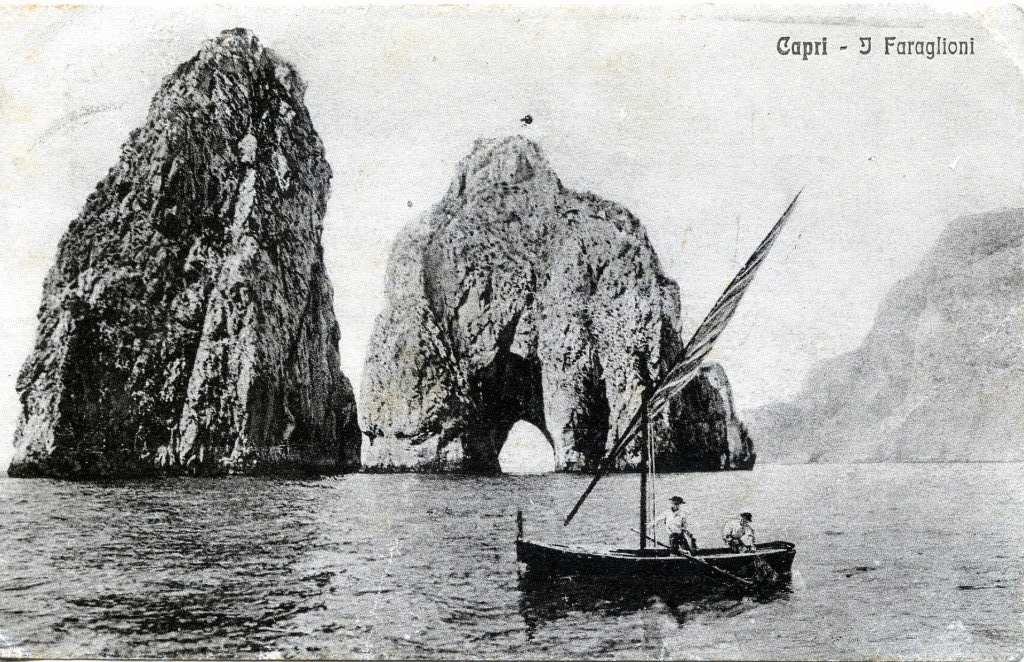
Capri is perhaps one of the most famous islands in the world, yet many people associate it only with its iconic Piazzetta and everything that surrounds it. But how many of you know that where the Piazzetta stands today, there was once the ancient Greek acropolis? Let’s start from the beginning.
According to some scholars, the name Capri was chosen by the people who inhabited the island before the Greeks; according to others, it was the Greeks themselves who named it. Capri would derive from Kaprìe or Kaprèai, meaning “goat.” Apparently, goats and wild boars were once abundant on the island.
However, the history of Capri begins long before the arrival of Greeks and Romans — around the Lower Paleolithic period — as evidenced by findings in the Grotta delle Felci, dating back roughly 400,000 years. At that time, the island, which unlike Ischia and Procida has no volcanic origin, was still connected to the Sorrento Peninsula. What was once a peninsula became an island only about 10,000 years ago.
Ancient sources recount that Emperor Augustus found “bones of giants” on the island — almost certainly the remains of prehistoric animals. The Greeks arrived only in the 7th century BC, most likely settlers from Cumae. Virgil mentions pirates called the Teleboi, but evidence strongly suggests the presence of the Cumans. They remained on the island until the 5th century BC, when Capri came under the influence of Neapolis.
From the Greeks to the Romans
From the Greek period, unfortunately, little remains beyond the memory and the names of the two towns that define the island: Capri, the land of goats, and Anacapri, the Capri “above.” The so‑called “Phoenician Steps,” which start from Marina Grande, also date back to this era, although the name is misleading. We also know that where the famous Piazzetta stands today, there was once the ancient acropolis.
The people who left the most visible traces of their presence were undoubtedly the Romans. Little is known about the period before the rise of Augustus, but we do know that the first emperor of Rome exchanged Capri for Ischia. The latter belonged to the Romans, while the Blue Island was under Neapolitan control. Augustus, however, fell in love with Capri and asked the Neapolitans to make the exchange.
From that moment on, Capri became a place of pleasure and retreat. Numerous leisure villas were built here to enjoy the views and the tranquility the island offered. Tradition even speaks of twelve villas built by Augustus and his successor Tiberius, each dedicated to a different deity. Only a few traces of these villas remain today — or rather, only three structures can be confidently linked to Roman villas. The most famous and best preserved is certainly Villa Jovis, located in Capri.

Leave a Reply